How does CRISPR/Cas9 work?
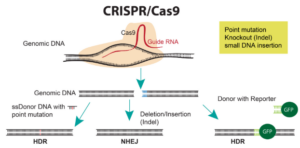
Cas9 is a site-specific nuclease that uses a guide RNA to target and cut precise DNA sequences in the genome.
- The Guide RNA System: In bacteria, Cas9 relies on two separate RNAs: a crRNA, which targets the nuclease to a specific sequence, and a tracrRNA, which binds to the crRNA to activate the Cas9 nuclease. For lab efficiency, these two molecules are combined into a single guide RNA (gRNA or sgRNA).
- DNA Repair & Editing: Cas9 creates double-strand DNA breaks (DSBs) that cells repair through one of two main pathways:
- NHEJ (Knock-outs) introduces small insertions or deletions (indels) to disrupt gene function.
- HDR (Knock-ins) uses a donor plasmid to achieve precise gene insertion or specific point mutations.
Ready to start your project?
Is CRISPR/Cas9 the Right Tool for Your Project?
| CRISPR/Cas9 is great for | CRISPR/Cas9 is challenging for |
|---|---|
| Introduction and correction of point mutations | |
| Gene knock-outs via frameshifts, indels and point mutations | Precise single-copy knock-in |
| Small knock-ins (less than 5 kb) | Large knock-ins > 5 kb – low efficiency |
| Dividing cells | Non-dividing cells – relies on homologous recombination |
| Academic and exploratory use | Commercial development due to complex IP landscape |
Tell us your
- target gene,
- host cell type, and
- payload size
to get a tailored recommendation and competitive quote for your project.